Bemærk
Adgang til denne side kræver godkendelse. Du kan prøve at logge på eller ændre mapper.
Adgang til denne side kræver godkendelse. Du kan prøve at ændre mapper.
Fails requests with a random selected error from file containing mocked errors.
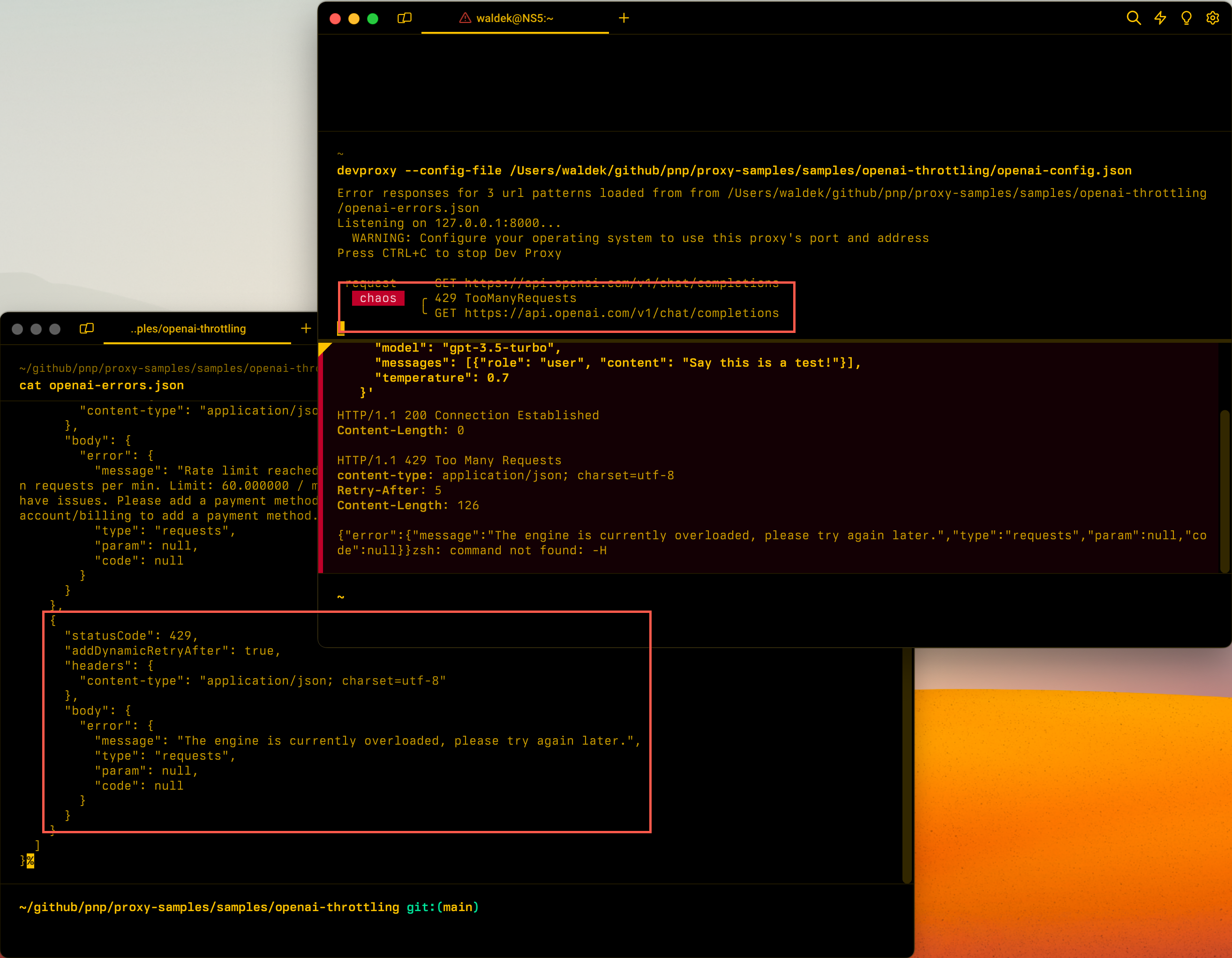
Configuration example
{
  "$schema": "https://raw.githubusercontent.com/dotnet/dev-proxy/main/schemas/v4.0.0/rc.schema.json",
  "plugins": [
    {
      "name": "GenericRandomErrorPlugin",
      "enabled": true,
      "pluginPath": "~appFolder/plugins/DevProxy.Plugins.dll",
      "configSection": "genericRandomErrorPlugin"
    }
  ],
  "urlsToWatch": [
    "https://api.openai.com/*"
  ],
  "genericRandomErrorPlugin": {
    "$schema": "https://raw.githubusercontent.com/dotnet/dev-proxy/main/schemas/v4.0.0/genericrandomerrorplugin.schema.json",
    "errorsFile": "errors.json"
  }
}
Configuration properties
| Property | Description | Default |
|---|---|---|
errorsFile |
Path to the file that contains error responses. | errors.json |
rate |
The percentage of requests to fail with a random error. Value between 0 and 100. | 50 |
retryAfterInSeconds |
The number of seconds to wait before retrying the request. Included on the Retry-After response header for dynamic throttling. |
5 |
Command line options
| Name | Description | Default |
|---|---|---|
-f, --failure-rate <failure rate> |
The percentage of requests to fail with a random error. Value between 0 and 100. | 50 |
Remarks
Response body
If you set the body property of an error response to a JSON object or array, Dev Proxy serializes it to JSON. If you set it to a string, Dev Proxy sends the string as-is, without surrounding quotes. A string that starts with @ is treated as a path to a file, relative to the errors file, with the response body. Because Dev Proxy defaults the Content-Type header to application/json, set the Content-Type header to match your content when you return non-JSON content, for example text/plain.
Per-response Retry-After values
Dev Proxy resolves @dynamic in the Retry-After header for any status code, like 429, 503, or 529. It matches the header name regardless of case. When it resolves @dynamic, it also registers the request with the RetryAfterPlugin, which reports requests that your app sends before the Retry-After time is up.
By default, the Retry-After header uses the global retryAfterInSeconds value. You can override this value on a per-response basis using the @dynamic=N syntax in the error responses file, where N is the number of seconds to wait before retrying.
{
  "$schema": "https://raw.githubusercontent.com/dotnet/dev-proxy/main/schemas/v4.0.0/genericrandomerrorplugin.errorsfile.schema.json",
  "errors": [
    {
      "request": {
        "url": "https://api.openai.com/*"
      },
      "responses": [
        {
          "statusCode": 429,
          "headers": [
            {
              "name": "Retry-After",
              "value": "@dynamic=17"
            }
          ],
          "body": {
            "error": {
              "message": "Rate limit exceeded. Wait 17 seconds."
            }
          }
        }
      ]
    }
  ]
}
In this example, the Retry-After header uses 17 seconds for this response, regardless of the global retryAfterInSeconds setting. The value increments on each subsequent throttled request, as with the plain @dynamic token.
Default Content-Type header
If an error response has a body and doesn't define a Content-Type header, Dev Proxy returns the response with the Content-Type: application/json header. To return a different content type, add the Content-Type header to the response in the errors file. Dev Proxy uses the value that you specify.
Next step
Samarbejd med os på GitHub
Kilden til dette indhold kan findes på GitHub, hvor du også kan oprette og gennemse problemer og pullanmodninger. Du kan få flere oplysninger i vores vejledning til bidragydere.

Dev Proxy